
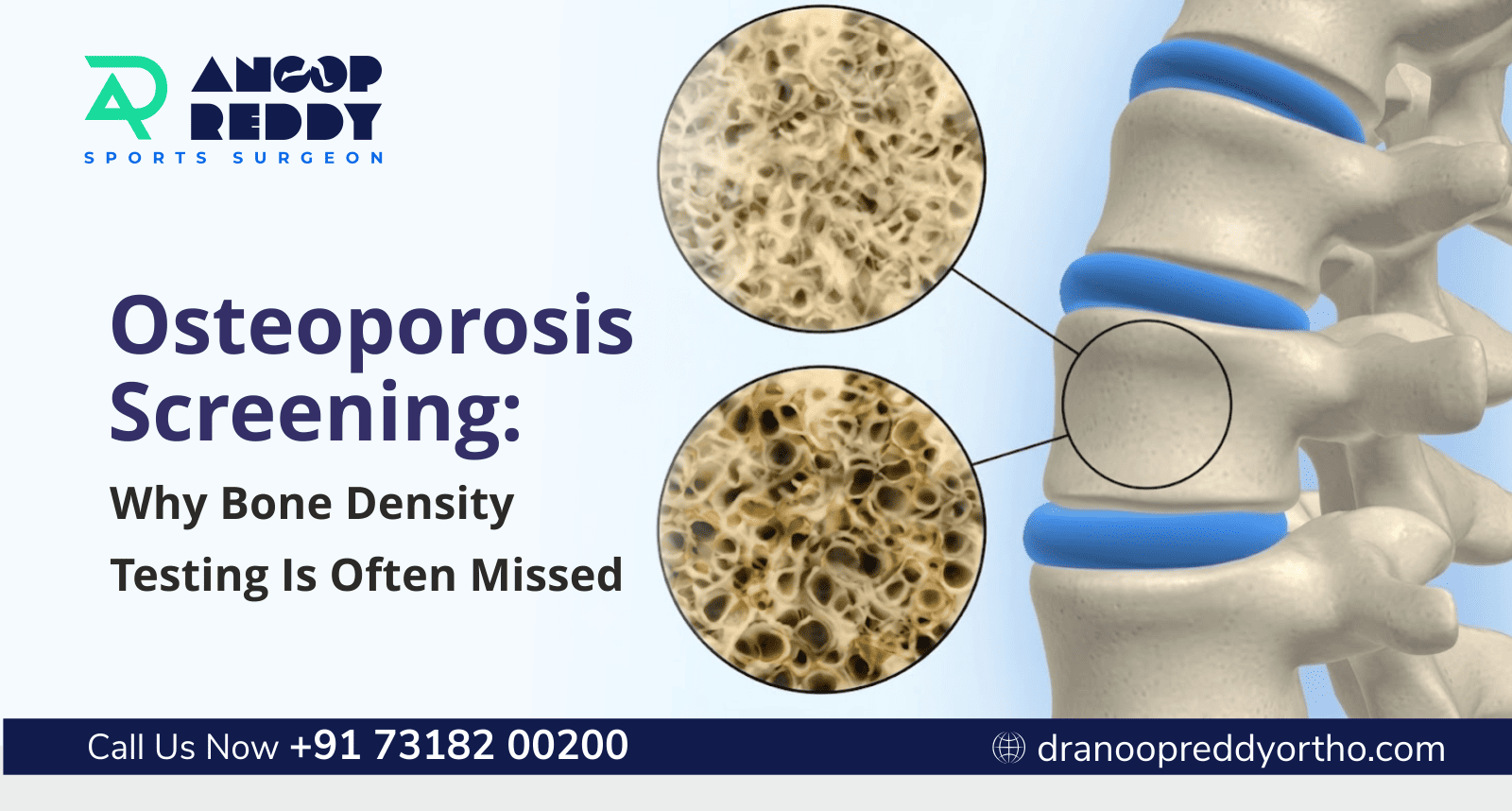
Osteoporosis screening, done through a simple bone density test called a DEXA scan, is one of the most effective tools in preventive orthopaedic care, yet global data consistently show that most people who should be screened never are. A 2026 systematic review found that osteoporosis treatment gaps range from roughly 39% to as high as 95% across different countries and populations, meaning a large share of high risk individuals are never identified or treated before a fracture occurs.
This article explains what osteoporosis screening involves, who should get tested, why bone density testing is so often missed, and what this means for joint health as you age. For related reading, see our articles on whether calcium and vitamin D supplements actually help your bones andwhat orthopaedic surgeons recommend before considering knee replacement.
Key Takeaways
• Osteoporosis screening is performed using a DEXA scan (dual-energy X-ray absorptiometry), a quick, low radiation test that measures bone mineral density (BMD) and produces a T-score.
• A 2026 systematic review found osteoporosis treatment gaps of 38.8% to 94.6% worldwide, with an average treatment gap of 71% among high fracture risk women in Europe.
• Screening gaps are worse in men: 2026 research presented at the World Congress on Osteoporosis found men are often referred for DEXA scans too late to gain the full benefit of treatment.
• In one 2026 study of older adults with a major osteoporosis risk factor, only about 20.5% had ever undergone a DEXA scan, despite clear guidelines recommending screening in this group.
• Undiagnosed osteoporosis significantly raises the risk of complications after hip and knee replacement surgery, including periprosthetic fracture and reoperation, according to a 2026 study of more than 3,300 joint replacement patients.
• Standard screening guidelines recommend bone density testing for women 65 and older, and earlier for postmenopausal women or men with specific risk factors, but awareness and referral gaps mean many eligible people are never tested.
What Is Osteoporosis and Why Does Bone Density Testing Matter?
Osteoporosis is a condition in which bones lose density and strength over time, becoming more porous and fragile, which significantly increases the risk of fractures, particularly in the hip, spine, and wrist. It often develops silently over years without symptoms, which is exactly why screening matters: most people don’t know they have weakened bones until a fracture occurs, sometimes from a fall that would not have injured someone with normal bone density. A DEXA scan, the standard test for osteoporosis screening, measures bone mineral density and compares it to that of a healthy young adult, generating a T-score. A T-score of -2.5 or lower indicates osteoporosis, while a score between -1.0 and -2.5 indicates osteopenia, a lower bone density state that also carries elevated fracture risk.
Who Should Get Osteoporosis Screening, and at What Age?
Bone density testing guidelines are fairly well established, but awareness of who qualifies remains inconsistent, which is part of why screening rates lag behind recommendations.
• Guidelines generally recommend bone density testing for all women aged 65 and older, regardless of additional risk factors.
• Postmenopausal women younger than 65 with increased risk, based on clinical risk assessment tools such as the Fracture Risk Assessment Tool (FRAX), should also be screened.
• Men are not as consistently included in routine screening recommendations, which contributes to significant underdiagnosis in this group, even though men also develop osteoporosis and experience fractures.
• Anyone who has already had a fragility fracture (a fracture from a fall from standing height or less) should be evaluated for osteoporosis, regardless of age, since this is one of the strongest predictors of future fracture risk.
Can Younger Adults or Men Develop Osteoporosis Too?
Yes, and this is a common misconception that contributes to under-screening. While postmenopausal women are at the highest and most well recognized risk due to the bone density loss that follows declining estrogen levels, men and younger adults with certain risk factors, including long term steroid use, low body weight, a family history of osteoporosis, or certain chronic illnesses, can also develop clinically significant bone loss. Research presented at the 2026 World Congress on Osteoporosis specifically found that men tend to be screened later in the disease course than women, which shortens the window during which treatment can meaningfully reduce fracture risk.
Why Is Osteoporosis Screening So Often Missed?
Despite clear clinical guidelines, a substantial share of people who should be screened for osteoporosis never receive a bone density test. A 2026 systematic literature review examining studies from multiple countries found reported treatment gap estimates ranging from 38.8% to 94.6%, with an average treatment gap of 71% among high fracture risk women across Europe according to the SCOPE 21 report cited in the review.
• Limited physician awareness and inconsistent referral patterns are frequently cited as system level barriers to screening.
• Patient level factors such as lower socioeconomic status, comorbidities, and male sex are associated with lower screening and treatment rates.
• A 2026 study of older adults with a major osteoporosis risk factor found that only about 20.5% had ever undergone a DEXA scan, despite clear indications for screening in this population.
• Structured care programmes, prior bone density testing, and older age were associated with higher screening and treatment rates, highlighting that consistent clinical pathways make a measurable difference.
Full details on the global treatment gap findings are available in the systematic literature review published in the Slovenian Journal of Public Health and in EMJ Reviews’ coverage of the 2026 World Congress on Osteoporosis findings on delayed screening in men.
Does a Normal-Looking Lifestyle Mean You Don’t Need Osteoporosis Screening?
Not necessarily. Osteoporosis develops silently, and many people with reduced bone density have no symptoms, normal weight, and otherwise healthy lifestyles right up until a fracture occurs. Screening recommendations are based on age, sex, and specific risk factors rather than how healthy someone appears, which is exactly why relying on visible signs or symptoms leads to so many missed diagnoses.
How Does Undiagnosed Osteoporosis Affect Joint Replacement Surgery?
For patients considering or undergoing hip or knee replacement, undiagnosed osteoporosis is a particularly important gap to close, since bone quality directly affects surgical outcomes.
• A 2026 study of more than 3,300 patients undergoing primary total hip or knee arthroplasty found that reoperation rates increased in a graded fashion from normal bone density to osteopenia to osteoporosis.
• Patients with osteoporosis had meaningfully higher rates of periprosthetic fracture, periprosthetic joint infection, readmission, and mortality within two years of surgery compared with those with normal bone density.
• Osteopenia, often considered a lower risk, borderline condition, was also associated with increased reoperation risk, suggesting it deserves more clinical attention than it often receives.
• Preoperative bone density testing before joint replacement can identify patients who may benefit from bone strengthening treatment or modified surgical planning before surgery.
How Is Osteoporosis Diagnosed and Risk Assessed?
• DEXA scan (dual-energy X-ray absorptiometry), the gold standard test, measuring bone mineral density at the hip and spine to generate a T-score.
• FRAX score (Fracture Risk Assessment Tool), a clinical calculator that estimates 10-year fracture risk based on age, bone density, and other risk factors.
• Clinical risk factor review, including prior fractures, family history, steroid use, smoking, alcohol use, and body weight.
• Blood tests, in some cases, to rule out secondary causes of bone loss, such as thyroid or parathyroid disorders.
What to avoid: Don’t assume that feeling physically fine or having no family history rules out osteoporosis, since the condition frequently has no symptoms until a fracture occurs. Don’t delay a bone density test if you are a woman 65 or older, a postmenopausal woman with risk factors, or anyone who has already had a fragility fracture, since earlier detection allows more time for treatment to meaningfully reduce fracture risk.
Is It Time to Get Screened for Osteoporosis?
Given how often bone density testing is missed, and how significantly undiagnosed osteoporosis can affect both fracture risk and joint replacement outcomes, proactive screening is worth discussing with your orthopaedic specialist, particularly if you fall into a higher risk group or are considering joint replacement surgery.
Consult Dr. Anoop Reddy Sama’s clinic if you or a loved one:
• Are a woman 65 or older who has not yet had a bone density test
• Have experienced a fracture from a minor fall or low impact injury
• Are considering hip or knee replacement surgery and want your bone health assessed beforehand
• Have risk factors such as long term steroid use, low body weight, or a family history of osteoporosis
Call +91 73182 00200 or book an appointment online to schedule a consultation.
Medically Reviewed & Approved By
Dr. Anoop Reddy Sama
MBBS, DNB Ortho, MCh Ortho (UK), Fellowship-Trained Orthopaedic & Sports Surgeon, Renova Century Hospitals, Banjara Hills, Hyderabad
Dr. Anoop Reddy Sama specializes in advanced shoulder and knee conditions, robotic joint replacement, and sports injury care. This article has been medically reviewed for accuracy as of September 2026 and reflects the most current research available on osteoporosis screening at the time of publication.
Medical References
2. EMJ Reviews. WCO 2026: Are Men Referred Too Late for Osteoporosis Screening? April 2026.
Frequently Asked Questions
1. What is osteoporosis screening and how is it done?
Osteoporosis screening is typically done through a DEXA scan, a quick, low radiation X-ray test that measures bone mineral density at the hip and spine and generates a T-score to assess fracture risk.
2. Who should get a bone density test?
Current guidelines recommend bone density testing for all women 65 and older, postmenopausal women younger than 65 with increased risk factors, and anyone who has already experienced a fragility fracture.
3. Why is osteoporosis screening so often missed?
Screening gaps are driven by limited physician awareness, inconsistent referral pathways, and patient level factors such as male sex, comorbidities, and lower socioeconomic status, with global treatment gap estimates ranging from about 39% to 95%.
4. Can men get osteoporosis, and are they screened as often as women?
Yes, men can develop osteoporosis, but they are screened less consistently and often later in the disease course than women, according to 2026 research presented at the World Congress on Osteoporosis.
5. What does a T-score mean on a bone density test?
A T-score of -2.5 or lower indicates osteoporosis, a score between -1.0 and -2.5 indicates osteopenia, and a score above -1.0 is considered normal bone density.
6. How does osteoporosis affect knee or hip replacement surgery?
Undiagnosed osteoporosis significantly raises the risk of complications after joint replacement, including periprosthetic fracture, infection, readmission, and reoperation, according to a 2026 study of over 3,300 arthroplasty patients.
7. Should I get a bone density test before knee or hip replacement surgery?
Discussing preoperative bone density testing with your orthopaedic surgeon is worthwhile, especially if you have risk factors for osteoporosis, since it can help guide surgical planning and post-surgical bone health management.
8. Does osteopenia also increase surgical risk, or only osteoporosis?
Osteopenia, often considered a lower risk, borderline condition, has also been associated with increased reoperation risk after joint replacement, suggesting it deserves clinical attention even though it is less severe than osteoporosis.
9. Is osteoporosis screening painful or time consuming?
No. A DEXA scan is quick, painless, and involves very low radiation exposure, making it one of the simplest and most accessible screening tests in preventive medicine.
10. What should I do if I think I’m at risk for osteoporosis but haven’t been screened?
Speak with your doctor about whether a DEXA scan is appropriate for you based on your age, sex, and risk factors, particularly if you are a woman 65 or older, postmenopausal with risk factors, or have already had a fragility fracture.