
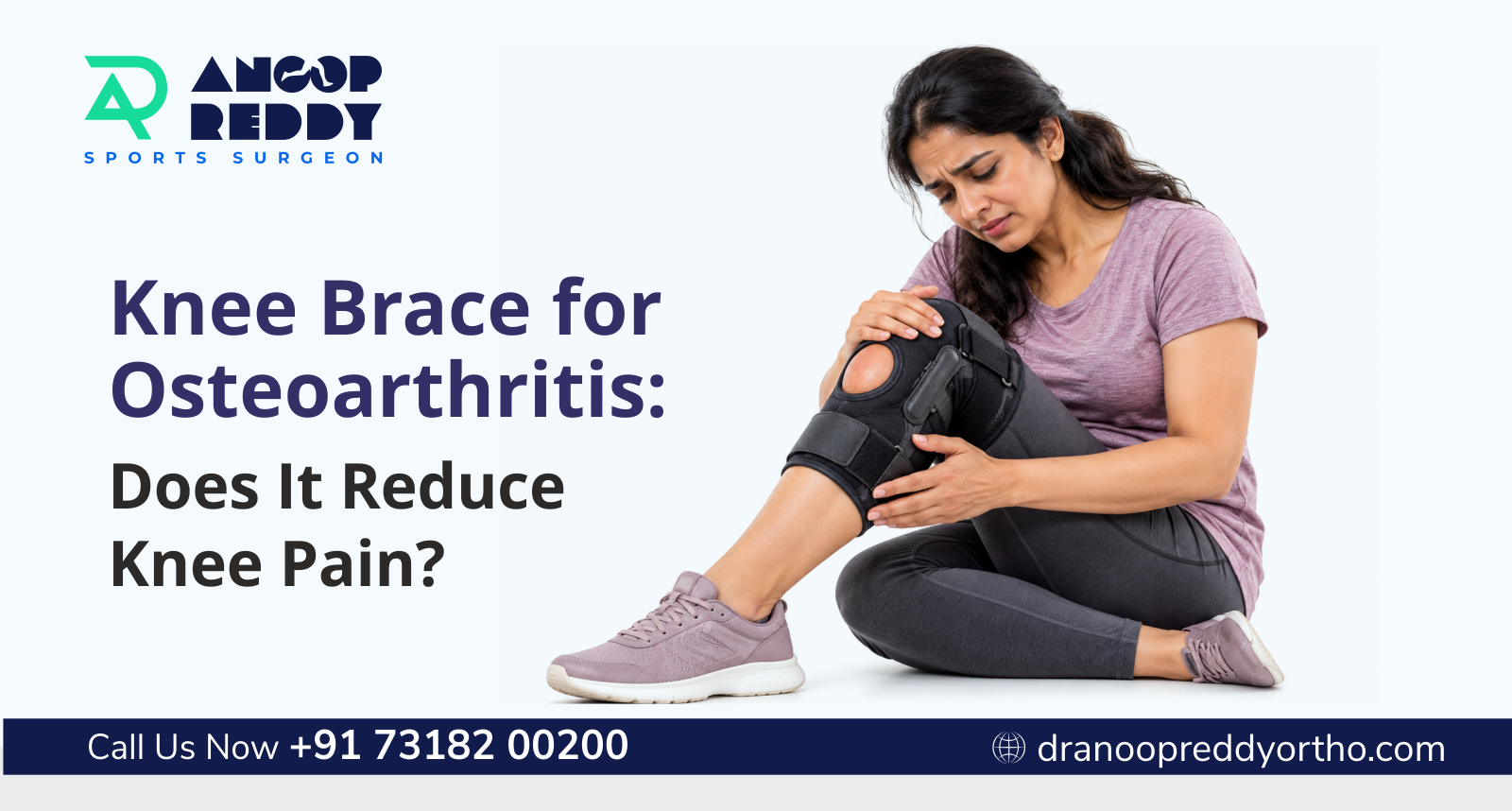
A knee brace for osteoarthritis may help reduce knee pain and improve function a little, but it is not a cure. In a 2026 BMJ randomised trial of 466 adults aged 45 and above, adding a knee brace (with support to help people keep wearing it) to standard advice, information and exercise gave a small but meaningful improvement in patient-reported outcomes at 3 and 6 months. By 12 months, the difference was no longer statistically significant. A brace works best as an add-on to exercise and weight management, never as a replacement. An orthopaedic surgeon can tell you whether a brace suits your type of knee arthritis.
Is knee arthritis making walking and stairs difficult?
Consult Dr. Anoop Reddy Sama, who specialises in knee preservation, sports injuries, arthroscopy and robotic-assisted joint replacement, for a personalised treatment plan.
Key Takeaways
- A knee brace may give modest pain relief in knee osteoarthritis, but it does not repair or regrow worn cartilage.
- The BMJ trial found small improvements at 3 and 6 months when a brace was added to exercise and advice. The benefit was no longer statistically significant at 12 months.
- Braces tend to suit people whose arthritis affects mainly one part of the knee, or who feel their knee is unstable.
- A brace cannot replace physiotherapy, strength training or weight loss, which remain the foundation of treatment.
- Skin irritation, soreness and blisters were reported in the brace group, so fit and skin care matter.
- A brace is not a way to avoid surgery for advanced, bone-on-bone arthritis.
When should you see an orthopaedic surgeon for knee pain?
Do not rely on a brace alone if you have knee pain at night or at rest, repeated swelling, locking, a feeling of the knee giving way, or difficulty straightening the knee. See a doctor the same day if your knee becomes suddenly hot, red and swollen, especially with fever, or if you cannot bear weight after a fall.
What is a knee brace for osteoarthritis and how does it work?
Knee osteoarthritis is a wear-and-tear condition in which the cartilage cushioning the joint gradually thins. It is extremely common. According to the Global Burden of Disease 2020 study published in The Lancet Rheumatology, about 595 million people worldwide were living with osteoarthritis in 2020, and this number is projected to rise by 75% by 2050.
A knee brace is an external support worn around the joint. Depending on the design, it may:
- Shift some load away from the more worn part of the knee
- Support the kneecap and improve how it tracks
- Provide warmth, compression and a sense of stability
- Give you the confidence to keep walking and exercising
How much each of these effects matters from person to person is still debated, which is why research on braces has been mixed for years.
Does a knee brace for osteoarthritis reduce knee pain? What the latest BMJ research says
Until recently, the evidence for knee braces came mostly from small studies. A large BMJ randomised trial (the PROP OA study) set out to answer the question properly.
How the study was done
- 466 adults aged 45 and above with knee osteoarthritis and moderate to severe pain during weight-bearing activity took part.
- One group received standard advice, information and exercise.
- The other group received the same plus a compartment-specific knee brace, along with an adherence support programme to help them keep using it.
- Researchers measured pain, symptoms and function using the KOOS-5 score at 3, 6 and 12 months.
What the researchers found
- At 3 months, the brace group improved more (an adjusted difference of about 3.7 points on the score).
- At 6 months, the advantage remained (about 3.4 points).
- At 12 months, the difference (about 2.7 points) was no longer statistically significant.
- Some people in the brace group had skin irritation, soreness or blisters.
- The brace group also had additional time with physiotherapists, which may have contributed to the benefit.
What this means for you
The improvement was real but modest, and it was strongest in the first six months. In other words, a brace may help you get through a painful phase and stay active while your exercise programme builds strength. It is not a long-term fix on its own, and the study does not show that a brace stops arthritis from progressing or prevents knee replacement.
Who benefits most from a knee brace for knee arthritis?
Not every arthritic knee responds to a brace in the same way. Braces are designed to change how load passes through the joint or how the kneecap moves, so they tend to work best when the problem is localised and the knee is still reasonably well aligned. They may also help more when worn alongside a structured exercise plan, such as the personalised rehabilitation approach Dr. Anoop recommends, because the brace helps you stay active through the painful phase.
A brace is more likely to help if:
- Your pain is mainly on one side of the knee (most often the inner side).
- Your arthritis is mild to moderate.
- You are bow-legged or knock-kneed, which overloads one side of the joint.
- Your knee feels unsteady or wobbly when you walk or climb stairs.
- You are doing physiotherapy and need extra support to keep exercising.
- You wear it consistently during the activities that trigger pain.
The PROP OA trial matched braces to the affected part of the knee, which is why a proper examination matters before you buy one.
Who may not benefit from a knee brace for osteoarthritis?
A brace is a mechanical aid, so it can only help when your pain truly comes from the part of the knee it is built to support. When arthritis is advanced, the joint is badly deformed, or the pain comes from another structure such as a torn meniscus or ligament (see our guide to common sports injuries), a brace may give little relief or may simply delay the right diagnosis. Practical issues such as fit, skin health and leg swelling also decide whether a brace is comfortable enough to wear regularly.
A brace is less likely to help, or needs medical advice first, if:
- Arthritis is severe and affects the whole joint.
- There is significant deformity or a fixed bent knee.
- Your leg is very swollen, or you have circulation problems or fragile skin.
- The brace does not fit properly, slips down or digs in.
- Your pain comes from a meniscus tear, ligament injury or loose fragment, which may need a different treatment.
- You expect the brace to work without exercise.
What a knee brace cannot do for knee osteoarthritis
It is easy to expect too much from a brace, especially when advertisements promise instant relief. A brace changes how forces pass through the knee and can make activity more comfortable, but it does not change the underlying condition of the joint. Structural problems are addressed by joint-preserving treatments such as arthroscopy, meniscus repair or cartilage restoration, which no brace can replace.
Being honest about limits is as important as explaining the benefits. A brace cannot:
- Regenerate or repair damaged cartilage
- Replace strengthening exercises and physiotherapy
- Correct severe deformity
- Guarantee that you will avoid knee replacement
- Fix mechanical problems such as meniscus tears that need treatment
If you are already asking whether surgery can be postponed, read our guide on whether you can delay knee replacement.
Types of knee braces for osteoarthritis: unloader, patellofemoral and sleeves
Knee braces for osteoarthritis come in several designs, and they are not interchangeable. The main difference is how much they change the way load travels through the joint: some are built to offload one side of the knee, some to guide the kneecap, and some simply provide warmth and compression. Choosing the right type depends on which part of your knee is affected, which is why a clinical examination and X-ray should come first.
- Unloader (offloading) braces: rigid or semi-rigid frames designed to reduce pressure on the more affected side of the knee. Usually considered when arthritis is concentrated on one side.
- Patellofemoral braces: support the kneecap and may help when pain is at the front of the knee, especially on stairs or when getting up from a chair.
- Soft sleeves and elastic supports: provide warmth and compression. They may be comfortable but do not mechanically offload the joint.
Generic braces from a medical shop are often cheaper but may not fit your leg shape or your pattern of arthritis. A brace that does not fit is more likely to cause skin problems and end up unused.
How to wear a knee brace for arthritis safely
Even the right brace helps only if it is worn correctly and consistently. In India’s warm and humid climate, sweating and friction can make skin problems more likely, and skin irritation and blisters were among the problems reported in the trial’s brace group. These practical steps help you gain the benefit while keeping your skin and joint safe, and they work best alongside the exercises in your rehabilitation plan.
- Get the brace chosen and fitted after a clinical examination and X-ray.
- Wear it during activities that provoke pain, such as walking, stairs and exercise, unless your surgeon advises otherwise.
- Check your skin daily for redness, blisters or pressure marks, particularly in hot and humid weather when sweating is heavy.
- Wear a thin cotton layer between skin and brace if advised, and wash the brace regularly.
- Loosen or remove the brace and call your doctor if you notice numbness, tingling, increased swelling or colour change in the leg.
- Keep doing your exercises. A brace should support your rehabilitation, not replace it.
Knee brace vs exercise, weight loss and injections: what works best for knee osteoarthritis?
Most people with knee osteoarthritis do best with a combination of treatments rather than a single fix. Guidelines place exercise and weight management at the base of care, with braces, medicines, injections and procedures added according to your symptoms and the stage of arthritis. Seeing where a brace fits in this larger picture helps you set realistic expectations and spend your money wisely.
A brace sits alongside other treatments rather than competing with them.
- Exercise: The American College of Rheumatology strongly recommends exercise as a first-line treatment for knee osteoarthritis. The same guideline offers a conditional recommendation for bracing in selected patients, meaning it may help some people but is not for everyone.
- Weight management: The IDEA trial published in JAMA showed that overweight patients who lost 10% or more of their body weight had greater improvements in pain and function than those who only exercised.
- Medicines and injections: These may ease flare-ups but do not repair cartilage. Learn more about PRP, stem cells and shockwave therapy.
- Joint preservation procedures: For selected, younger or active patients, options such as arthroscopy, meniscus repair, cartilage restoration or high tibial osteotomy may be considered.
Knee problems are also appearing earlier than before. Read why in our article on knee problems in young Indians.
Not sure whether a knee brace is right for you?
The right brace depends on which part of your knee is affected, your alignment, your activity level and your overall plan. A short examination can save you from buying the wrong one.
Book a consultation with Dr. Anoop Reddy Sama at Renova Century Hospitals, Banjara Hills, for a personalised plan based on your symptoms, lifestyle and imaging. You can also explore orthopaedic treatments offered.
When is a knee brace not enough for knee arthritis?
A brace can keep you comfortable and active, but it cannot hold back advanced arthritis indefinitely. Knowing when to move on from bracing and ask for a surgical opinion helps you avoid months of avoidable pain and muscle loss. Dr. Anoop Reddy Sama evaluates your symptoms, daily function and imaging together before advising what comes next.
It may be time to look beyond a brace if:
- Pain continues despite physiotherapy, medication and bracing.
- Walking short distances, climbing stairs or sleeping becomes difficult.
- Your knee swells repeatedly or gives way.
- Deformity is increasing.
- X-rays show advanced bone-on-bone arthritis.
- Your quality of life is declining.
At that stage, delaying a surgical opinion can lead to weaker muscles, lower mobility and a harder recovery. Meeting an experienced orthopaedic surgeon early lets you choose the best time and option rather than reacting to a crisis.
Take the next step for your knee pain
A brace may buy you some comfort, but lasting relief usually comes from the right combination of exercise, weight management and, when needed, the right procedure at the right time. Book an appointment with Dr. Anoop Reddy Sama or call 73182 00200.
Related reading: Can You Delay Knee Replacement? | Why Are Indians Getting Knee Problems Earlier Than Ever? | PRP, Stem Cells and Shockwave Therapy | Common Sports Injuries and When to See an Orthopaedic Doctor | Robotic Joint Replacement
Frequently Asked Questions
Does a knee brace help osteoarthritis pain?
It may help a little. In the BMJ trial, adding a brace to exercise and advice led to small improvements in pain and function at 3 and 6 months, but the difference was not statistically significant by 12 months.
Can a knee brace cure knee arthritis?
No. A brace can support the joint and may ease symptoms, but it cannot repair cartilage or reverse arthritis.
Which knee brace is best for osteoarthritis?
The best brace depends on which part of your knee is affected. Unloader braces are used for arthritis on one side, patellofemoral braces for kneecap pain, and soft sleeves for mild support and warmth. An orthopaedic examination helps you choose.
Should I wear a knee brace all day?
Most people wear a brace during activities that cause pain, such as walking and exercise. Whether to wear it all day depends on your condition, so follow your surgeon’s advice.
Can I sleep with a knee brace on?
Generally it is not needed at night. If your knee hurts at night, see a doctor rather than relying on a brace.
Can a knee brace help me avoid knee replacement?
The trial did not test this. A brace may help you stay active, but exercise, weight loss and timely medical care matter more for delaying surgery.
Are knee braces safe?
Most people tolerate them, but skin irritation, soreness and blisters can occur, especially in hot and humid weather or with a poor fit. Stop using the brace and consult your doctor if you notice numbness, swelling or colour change in your leg.
Is a knee brace better than a knee cap or elastic sleeve?
Sleeves give warmth and mild compression but do not shift load away from the joint. Structured braces may do more for selected patients, though the benefit is still modest.
Do I still need physiotherapy if I wear a knee brace?
Yes. Exercise is the cornerstone of treatment. In the trial, the brace was added to exercise and advice, not used instead of them.
When should I see a doctor instead of buying a brace?
See an orthopaedic surgeon if pain is severe, wakes you at night, comes with locking, swelling or giving way, or does not improve with a few weeks of exercise and simple measures.