
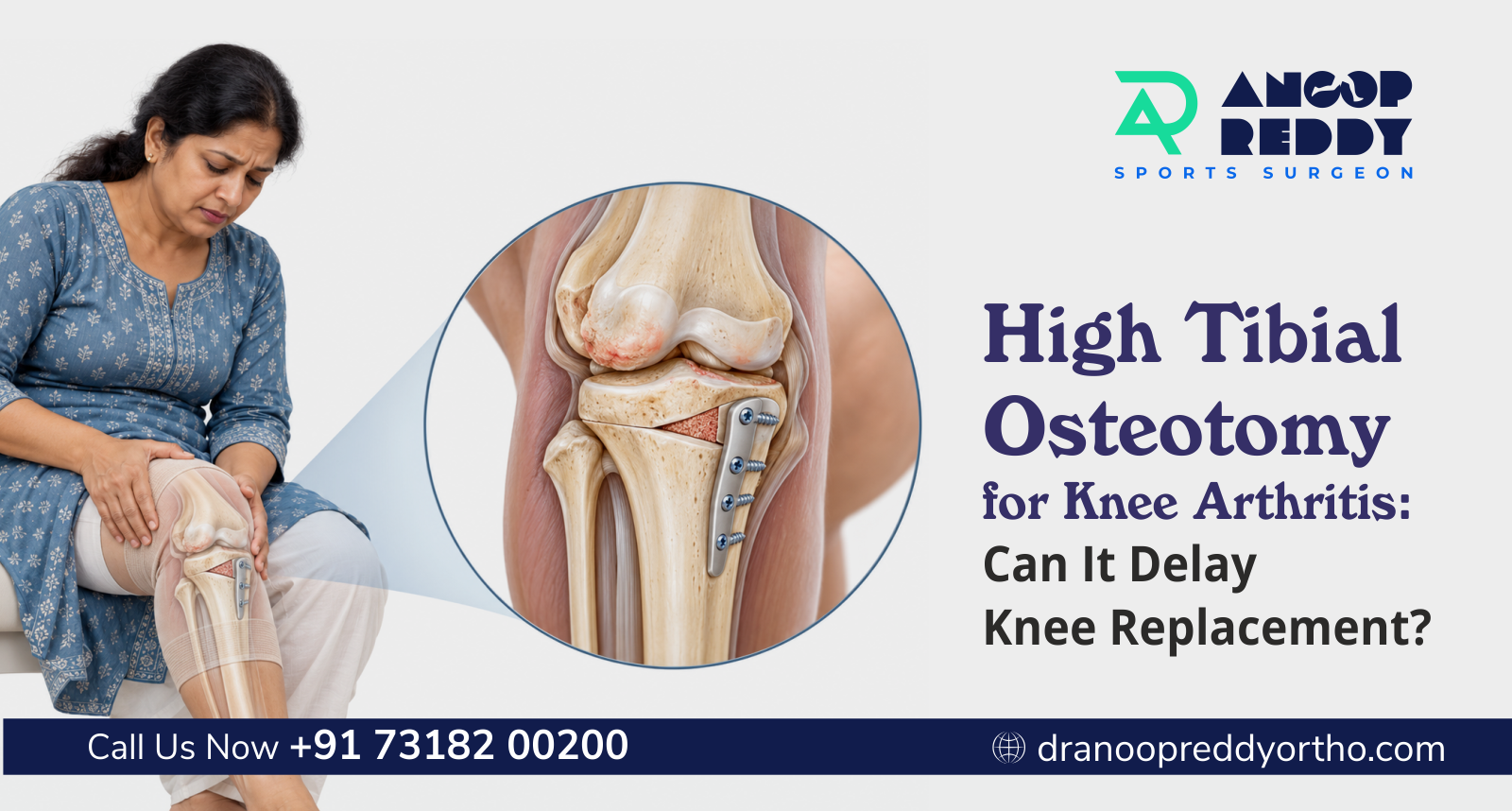
Yes, for the right patient. High tibial osteotomy (HTO) is a joint-preserving surgery that realigns the shin bone to shift body weight away from a worn part of the knee. It is mainly used in younger, active people whose arthritis affects the inner side of the knee and who are bow-legged. A 2025 randomised trial in the Annals of Internal Medicine found that adding HTO to non-surgical care slowed cartilage loss and improved knee scores over two years compared with non-surgical care alone. HTO does not cure arthritis or guarantee you will never need a knee replacement, but it can buy several good years. An orthopaedic surgeon can tell you if your knee is suitable.
Is knee arthritis limiting your work, sport or daily walking?
Consult Dr. Anoop Reddy Sama, who specialises in knee joint preservation, sports injuries, arthroscopy and robotic-assisted joint replacement, for a personalised treatment plan.
Key Takeaways
- HTO is an alignment-correcting surgery that preserves your natural knee. It is not a knee replacement.
- It works best in younger, active patients with inner-side (medial) knee arthritis and bow legs, when the rest of the knee is still healthy.
- In a 2025 randomised trial of 145 adults, HTO plus non-surgical care slowed cartilage loss and gave a larger improvement in knee scores than non-surgical care alone at two years.
- Reported 10-year survival (knees not yet replaced) varies widely, from roughly 75% to 98%, depending on how carefully patients are selected.
- Recovery takes months, not weeks, because the bone has to heal in its new position.
- HTO may delay knee replacement for many years, but some patients will still need one later.
When should you see an orthopaedic surgeon for knee arthritis?
Do not wait if you have knee pain on the inner side that limits walking, an increasingly bow-legged look, pain at night, swelling or a knee that feels unstable. Seek care the same day if the knee suddenly becomes hot, red and swollen, especially with fever, or if you cannot bear weight after a fall. Early assessment keeps more treatment options open, including joint-preserving surgery.
What is high tibial osteotomy (HTO) for knee arthritis and how does it work?
Knee arthritis often wears one side of the joint faster than the other. In many bow-legged knees, body weight passes mostly through the inner (medial) compartment, so its cartilage thins first and pain follows. High tibial osteotomy tackles this mechanical problem directly. The surgeon cuts the upper part of the shin bone (tibia), gently adjusts its angle and fixes it with a plate and screws so the load shifts towards the healthier side of the knee.
The two common techniques are:
- Medial opening wedge HTO: the bone is cut from the inside and opened slightly, then held with a plate. This is the technique studied in the 2025 trial discussed below.
- Lateral closing wedge HTO: a small wedge of bone is removed from the outer side and the gap is closed.
By changing the alignment, HTO aims to relieve pain, protect the remaining cartilage and let you stay active on your own knee. Our guide on whether you can delay knee replacement explains the other steps that come before surgery.
Can high tibial osteotomy delay knee replacement? What the latest research says
For years, most HTO evidence came from observational studies. A randomised trial published in 2025 in the Annals of Internal Medicine added stronger evidence by testing HTO against non-surgical care alone.
How the trial was done
- 145 adults with bow-legged alignment and symptomatic arthritis mainly on the inner side of the knee took part.
- One group had medial opening wedge HTO plus non-surgical care.
- The comparison group had non-surgical care alone, including three months of supervised exercise, nutrition counselling and pain medicines as needed.
- The main outcome was change in cartilage thickness on MRI over two years. Knee function was tracked using the KOOS score.
What the researchers found
- Cartilage loss over two years was about 2% in the HTO group versus about 9% in the non-surgical group.
- KOOS scores improved by about 25 points after HTO and about 9 points with non-surgical care, a difference of roughly 16 points.
- Results favoured HTO in patients who chose their own treatment as well.
- The study was done at a single centre and followed patients for two years, so longer-term results still matter.
What this means for you
This is encouraging evidence that, in carefully selected patients, correcting alignment can slow structural damage and improve how the knee feels and works. It does not show that HTO prevents knee replacement forever, which is why long-term survival data are also important.
How long does a high tibial osteotomy last before knee replacement is needed?
HTO is not a permanent fix, but it can delay replacement for many years. Published numbers differ because studies include different kinds of patients, and results depend on how severe the arthritis was and how well the alignment was corrected. Younger patients with limited arthritis generally do better than those with advanced damage.
- A systematic review of HTO combined with cartilage procedures found conversion to knee replacement in about 4.5% of patients within 5 years, 8.3% between 5 and 10 years and 11.2% beyond 10 years.
- A 2024 review in patients with radiologically advanced inner-side arthritis reported average survival of 74.6% at 10 years, with a wide range from 60% to 98.1%.
- A meta-analysis of knee replacement after HTO noted reported 10-year survival of 79% to 97.6% and 15-year survival of 56% to 65.5%.
- A pooled analysis found 10-year survival of about 91.6% for opening wedge versus 85.4% for closing wedge HTO, although most of the underlying studies were of lower quality.
Taken together, the message is consistent: many patients get a decade or more before needing a replacement, but the more advanced the arthritis, the shorter the benefit tends to be.
Who is a good candidate for high tibial osteotomy?
The success of HTO depends heavily on choosing the right patient. Surgeons look at your age, activity level, the pattern of arthritis on X-ray and MRI, and the alignment of your whole leg. Because every knee is different, your surgeon will judge suitability case by case, but in general HTO may be considered if:
- You are younger and active, often in your 30s to 50s, though biological age and fitness matter more than the number.
- Pain is mainly on the inner side of the knee.
- Your legs are bow-legged (varus alignment).
- The outer side of the knee and the kneecap joint are in reasonably good condition.
- Your knee moves well and the ligaments are stable.
- You are motivated to follow a structured rehabilitation programme.
- You would like to keep a high level of activity, such as sport, squatting or sitting cross-legged.
Knee problems now appear earlier in India than they used to. Read why in our article on knee problems in young Indians.
Who is not a good candidate for HTO knee surgery?
HTO is not suitable for every arthritic knee, and doing it in the wrong patient can lead to poor results. Widespread arthritis, an unstable joint or conditions that affect bone healing generally make osteotomy less likely to succeed. A surgeon may advise against HTO or suggest other options if you have:
- Arthritis affecting the whole knee or all three compartments
- Significant damage to the outer compartment or kneecap joint
- A stiff knee that does not straighten or bend well
- Inflammatory arthritis such as rheumatoid arthritis
- Marked ligament instability that is not being addressed
- Very high body weight, heavy smoking or other factors that may impair bone healing
- Expectations of a quick recovery with no rehabilitation
If your pain comes from a torn meniscus or ligament rather than arthritis, a different treatment may be better. See our guide to common sports injuries.
High tibial osteotomy vs knee replacement: which is better for knee arthritis?
Neither option is better for everyone. HTO preserves your natural knee and suits younger, active patients with localised arthritis, while knee replacement gives more predictable pain relief in older patients with advanced, widespread arthritis. The right choice depends on your age, the stage of arthritis, your alignment, your activity goals and your overall health.
| High tibial osteotomy (HTO) | Total knee replacement | |
|---|---|---|
| What it does | Realigns the shin bone to offload the worn side | Replaces the worn joint surfaces with implants |
| Best suited to | Younger, active, bow-legged, inner-side arthritis | Advanced, widespread arthritis, usually older patients |
| Natural knee kept | Yes | No |
| Recovery | Months, while bone heals | Often faster return to daily walking |
| Activity afterwards | May allow higher-demand activity | Usually lower-impact activity advised |
| Future surgery | May need knee replacement later | Implants can wear and may need revision in the long run |
To understand how long modern implants usually last, read our guide on delaying knee replacement. A knee replacement after HTO is possible, but surgeons note that conversion surgery can be more technically demanding, which is one more reason to choose carefully.
What is recovery like after high tibial osteotomy?
Because HTO involves cutting and healing bone, recovery is slower than for arthroscopy but is usually planned around protecting the bone while it unites. Your surgeon will give you a personalised schedule based on the technique and fixation used. In general, recovery follows these stages:
- The first few weeks: pain control, swelling management and walking with crutches, with limited weight on the operated leg.
- Early rehabilitation: gentle movement to regain bend and straightening, and early muscle activation.
- Strengthening phase: gradually increasing weight-bearing, strength and balance work with a physiotherapist.
- Return to activity: desk work may resume sooner, while running and sport usually take several months and need surgeon clearance.
Good rehabilitation is as important as the operation itself. See how we plan personalised rehabilitation for each patient.
What are the risks of high tibial osteotomy surgery?
Like any major surgery, HTO has risks, and understanding them helps you decide with confidence. Most patients do well, but complications can happen, particularly when patient selection or technique is not ideal. Your surgeon should discuss the following with you:
- Infection or wound problems
- Slow or incomplete bone healing
- Over- or under-correction of the alignment
- Irritation from the plate and screws, sometimes needing later removal
- Stiffness or persistent pain
- Blood clots in the leg
- Rare injury to nerves or blood vessels
- The need for knee replacement later
Not sure whether high tibial osteotomy is right for your knee?
The right treatment depends on your alignment, the pattern of arthritis, your age and what you want to be able to do. A careful examination, standing leg X-rays and sometimes MRI can show whether you are a candidate for joint preservation or whether another option is better.
Book a consultation with Dr. Anoop Reddy Sama at Renova Century Hospitals, Banjara Hills, for a personalised plan based on your symptoms, lifestyle and imaging. You can also explore orthopaedic treatments offered.
When is it too late for high tibial osteotomy and time to consider knee replacement?
Postponing treatment for too long can close the window for joint preservation. Once arthritis spreads across the whole knee, alignment correction can no longer take pressure off a healthy area. Dr. Anoop Reddy Sama evaluates your symptoms, daily function and imaging together before advising which option makes sense at your stage.
It may be time to discuss knee replacement rather than HTO if:
- Arthritis has spread to the outer side or the kneecap joint
- X-rays show advanced bone-on-bone arthritis in most of the knee
- Pain persists despite exercise, medication and other treatment
- Walking short distances, climbing stairs or sleeping has become difficult
- You are older and mainly want a predictable improvement in daily comfort
- Your quality of life is steadily declining
Delaying an assessment can reduce your choices, so seeing a specialist early gives you the best chance of keeping your own knee.
Take the next step for your knee pain
HTO can be an effective way to keep a bow-legged, arthritic knee working and delay replacement, but only when the right patient meets the right surgical plan. Book an appointment with Dr. Anoop Reddy Sama or call 73182 00200.
Related reading: Can You Delay Knee Replacement? | Why Are Indians Getting Knee Problems Earlier Than Ever? | PRP, Stem Cells and Shockwave Therapy | Personalised Orthopedic Care and Rehabilitation | Robotic Joint Replacement
Frequently Asked Questions
What is high tibial osteotomy?
High tibial osteotomy is a surgery in which the upper shin bone is cut, realigned and fixed with a plate to shift weight away from a worn part of the knee. It aims to relieve pain and protect the remaining cartilage.
Can high tibial osteotomy delay knee replacement?
In suitable patients, yes. Many people get several years or more before needing a replacement, but the benefit varies with age, the severity of arthritis and how well the alignment is corrected.
Who is the ideal candidate for HTO?
Typically a younger, active person with bow legs and arthritis mainly on the inner side of the knee, with a healthy outer compartment, good movement and stable ligaments.
What is the success rate of high tibial osteotomy?
Success depends on patient selection. Published 10-year survival (knees not converted to replacement) ranges from roughly 75% to 98% across studies, with better results in less advanced arthritis.
How long does it take to recover from HTO?
Recovery takes months because the bone must heal. Most people use crutches for the first weeks, return to desk work sooner, and need several months before sport or heavy activity. Your surgeon will guide the timeline.
Is HTO better than knee replacement?
Not necessarily. HTO preserves your own knee and suits younger, active patients with localised arthritis. Knee replacement is usually better for older patients with advanced, widespread arthritis.
Can I have knee replacement after HTO?
Yes. Knee replacement can be done after HTO, though the surgery may be more technically demanding, so careful planning matters.
Is high tibial osteotomy painful?
There is pain after surgery, as with any operation involving bone. It is managed with medication, ice, elevation and physiotherapy, and usually settles as the bone heals.
Can high tibial osteotomy cure arthritis?
No. It does not cure arthritis, but by correcting alignment it may reduce pain, slow cartilage loss and help you stay active for longer.
When should I see a doctor about knee arthritis?
See an orthopaedic surgeon if inner-side knee pain limits your daily life, your legs look increasingly bow-legged, pain disturbs your sleep, or the knee swells or gives way. Seeing a specialist early keeps more treatment options open.