
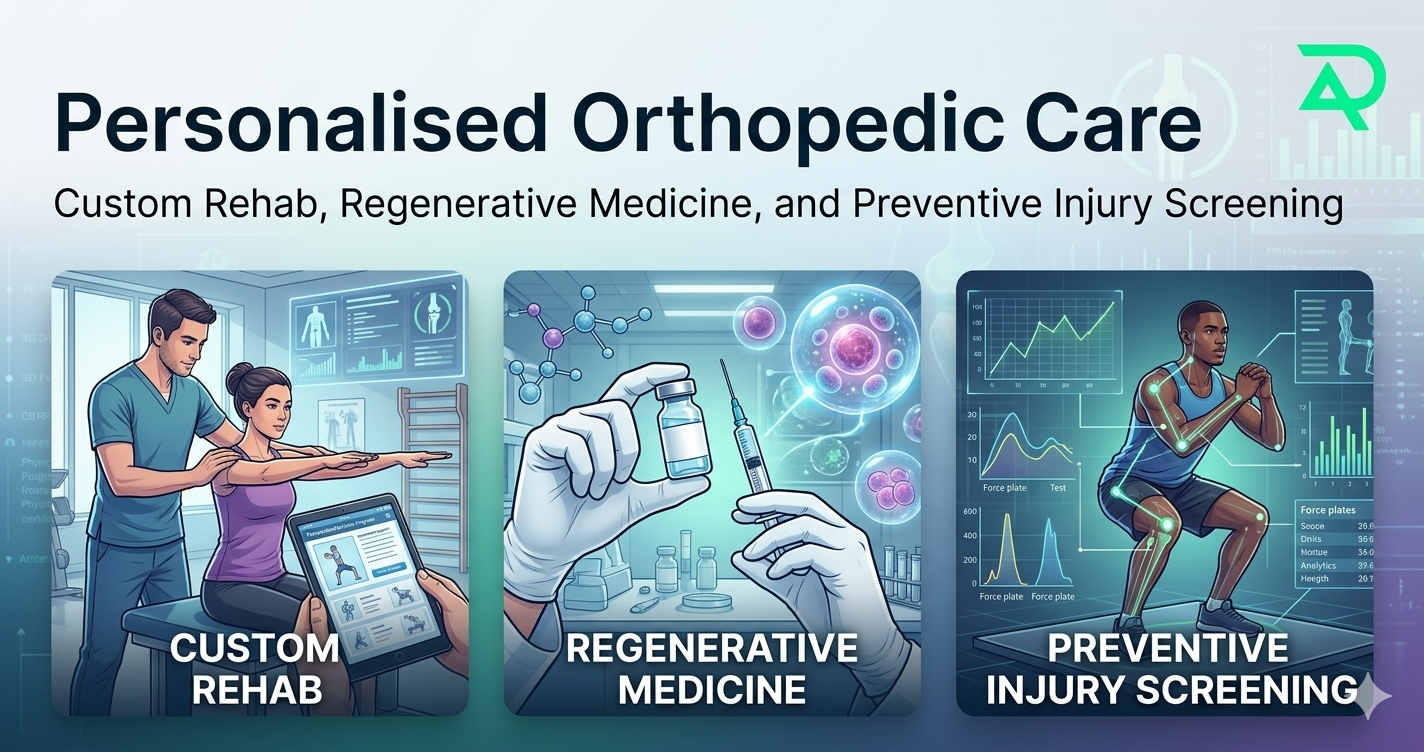
Key Takeaways:
- No two injuries are the same – Personalised orthopedic care built around your biology, activity level, and goals outperforms generic treatment every time.
- Custom rehab cuts re-injury rates by up to 51% – A program designed for your specific injury and lifestyle is the difference between real recovery and revolving-door pain.
- Regenerative therapies like PRP and stem cells treat the source – Not just the symptoms- and can delay or eliminate the need for surgery in the right candidates.
- Most serious injuries are predictable – Injury prevention screening catches biomechanical red flags before they become torn ligaments or chronic joint damage.
- The best orthopedic care does not stop at pain relief – It rebuilds strength, corrects movement, and keeps you from ending up back in the same chair.
Let us be honest: most people do not think about their joints until something goes wrong. A sudden pop during a morning run. A shoulder that just would not stop aching. A knee that swells after a long day. And when they finally walk into an orthopedic care clinic, what do they usually get? A generic treatment plan that could have been handed to anyone.
That is the problem. And it is why so many patients end up back in the same chair, with the same pain, wondering why nothing is sticking.
The good news? Orthopedic medicine is changing fast. Here is what modern, personalised care actually looks like, and why it makes all the difference.
Moving Beyond Standardised Orthopedic Treatment
According to the Bone and Joint Initiative USA, musculoskeletal conditions affect over 1.71 billion people worldwide, the leading cause of disability globally. Yet for decades, treatment has largely followed the same playbook: rest, anti-inflammatories, maybe surgery.
The reality is that two patients with the same diagnosis can be worlds apart. A personalised orthopedic care centre approach accounts for:
• Age and activity level – A 28-year-old cricketer heals differently from a 55-year-old desk professional
• Tissue quality and healing capacity – Influenced by nutrition, sleep, and underlying health
• Biomechanical patterns – How you move is often the root cause of why you got injured
• Personal goals – Returning to sport vs. returning to daily life requires completely different benchmarks
Instead of treating the scan, a total orthopedic care model treats the person behind it.
Custom Rehabilitation: Where Real Recovery Happens
Most people picture rehab as a few exercises on a printout. In reality, a well-designed program at a quality rehabilitation centre is one of the most evidence-backed interventions in medicine, but only when it is specific to the patient.
A 2021 review in the Journal of Orthopaedic & Sports Physical Therapy found that individualised rehab protocols reduced re-injury rates by up to 51% compared to generic programs. That is the difference between getting your life back and cycling through the same injury on repeat.
The types of rehabilitation used in modern orthopedic care go well beyond basic physio:
• Neuromuscular re-training – Restoring the brain-muscle communication that injury disrupts
• Sport- or occupation-specific movement work – Mimicking the real demands of your daily life
• Progressive loading protocols – Stressing healing tissue in precisely the right ways, at the right time
• Strength and conditioning – Building resilience, not just restoring baseline
• Gradual return-to-activity plans – Structured milestones, not guesswork
A comprehensive orthopedic & spine care approach means rehab does not end when the pain stops. It ends when the patient is genuinely ready, stronger, more stable, and less likely to come back injured.
Regenerative Medicine: Treating the Source, Not the Symptom
If there is one area of orthopedics that is genuinely exciting right now, it is regenerative medicine. So what is regenerative medicine? Simply put, it is using biological therapies to stimulate the body’s own healing mechanisms, like repairing tissue rather than just managing pain around it.
Platelet-Rich Plasma (PRP)
PRP involves concentrating platelets from the patient’s own blood and injecting them into the injured tissue. Platelets carry growth factors that accelerate repair. Because the material is the patient’s own, the risk profile is very low.
Commonly used for:
• Tennis elbow and rotator cuff injuries
• Chronic tendonitis
• Early-stage osteoarthritis
A meta-analysis in the American Journal of Sports Medicine found PRP produced significantly better outcomes than corticosteroid injections for chronic tendinopathy, with effects lasting up to 12 months.
Stem Cell Therapy
The use of regenerative medicine stem cells takes things further. Stem cells can differentiate into cartilage, tendon, and bone, making them particularly relevant for joint degeneration that would traditionally head toward replacement surgery.
Key facts worth knowing:
• Best suited for moderate joint degeneration, not end-stage disease
• Can delay or reduce the need for surgery in suitable candidates
• The global orthopedic stem cell therapy market is projected to grow at over 10% CAGR through 2030, a signal of how rapidly the evidence and adoption are building
Neither PRP nor stem cell therapy is a universal fix. Suitability depends entirely on the individual case, which is exactly why personalised assessment matters so much.
Preventive Injury Screening: Stop the Injury Before It Happens
Here is something that does not get talked about enough: most serious orthopedic injuries are predictable. The biomechanical warning signs are often present for months, sometimes years, before the injury occurs.
Muscle imbalances. Restricted mobility. Asymmetrical movement patterns. Postural compensations built up over years at a desk or years on a field. Injury prevention screening is designed to catch all of it.
A thorough screening assessment evaluates:
• Joint mobility and flexibility
• Muscle strength and left-right imbalances
• Movement mechanics under load
• Postural alignment
• Previous injury history is one of the strongest predictors of future injury
The results are compelling. Research in the British Journal of Sports Medicine found that athletes who completed movement screening and targeted corrective programs reduced ACL injury rates by up to 70%. For shoulder instability and overuse injuries, outcomes were similarly strong.
And this is not just for athletes. Anyone, office workers, manual labourers, or older adults can benefit from knowing where their weak links are before those weak links fail under pressure.
The Bigger Picture: Precision Orthopedics Is Here
Orthopedic care has always been about getting people back to their lives. What is changed is how precisely and proactively we can now do that, with rehab built around the individual, biological therapies that support real tissue repair, and screening that catches problems before they become injuries.
Research projections estimate over 1 billion people may be affected by musculoskeletal disorders by 2050, highlighting the growing burden on healthcare systems.
The question to ask any orthopedic specialist is not just “what is wrong?” It is: “what is the plan that is actually right for me?”
FAQs
What is personalised orthopedic care?
Treatment tailored to your specific injury, body, and goals — not a generic protocol.
Who benefits from custom rehabilitation?
Athletes, post-surgical patients, people with chronic joint pain, and anyone who wants a recovery plan built around their actual life.
Is PRP therapy safe?
Yes, it uses the patient’s own blood, so rejection risk is minimal. Mild soreness at the injection site is the most common side effect.
Can regenerative treatments replace surgery?
In early to moderate cases, sometimes yes. It depends on the condition and the patient. A specialist assessment will determine what is appropriate.
What happens during injury prevention screening?
A specialist assesses your movement patterns, strength, flexibility, posture, and injury history to identify risk factors before they become injuries.
How long does orthopedic rehab take?
Anywhere from a few weeks to several months, depending on the injury and treatment. A personalised timeline is always more useful than a generic one.
Can screening improve athletic performance?
Yes. Correcting biomechanical inefficiencies improves movement quality and power output — not just injury risk.