
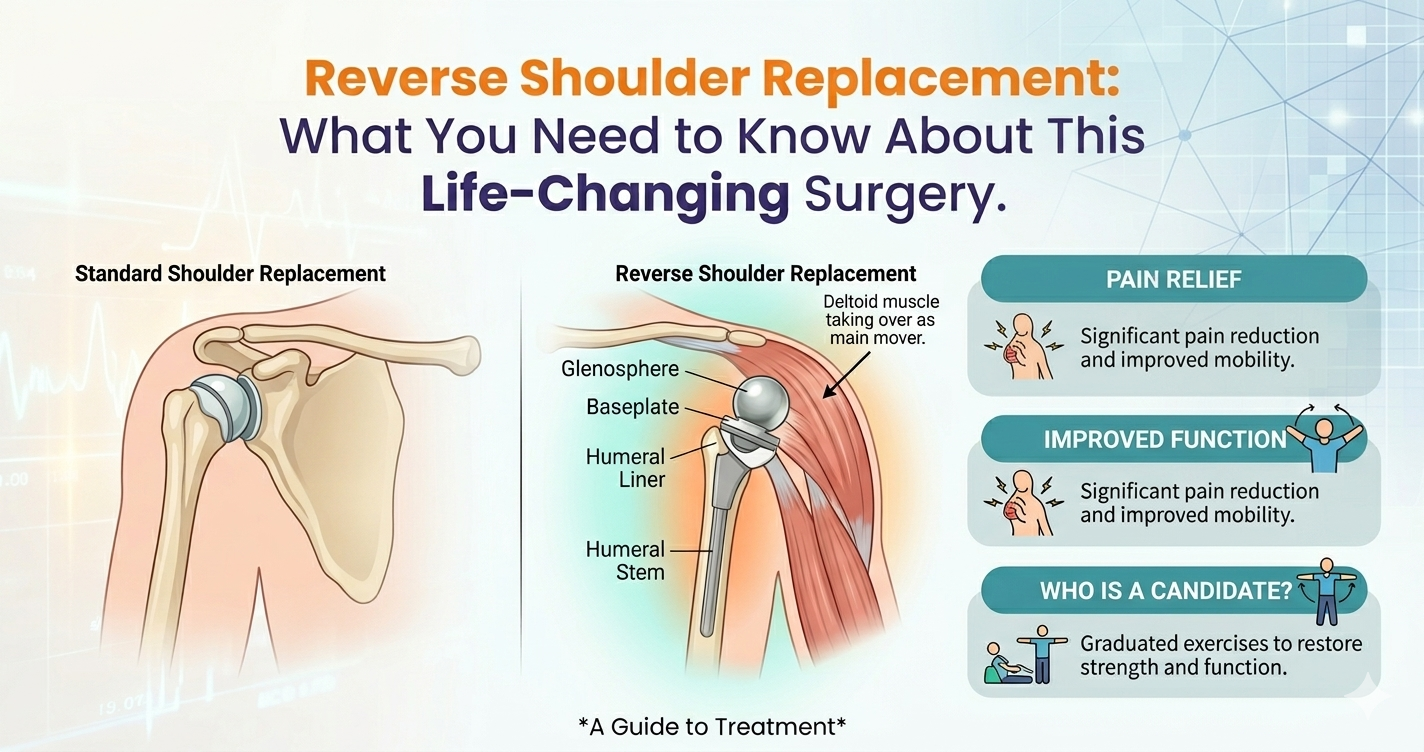
Reverse shoulder replacement is a surgical procedure in which the normal ball-and-socket structure of the shoulder joint is deliberately switched, the ball is placed on the shoulder blade and the socket on the upper arm bone, allowing the deltoid muscle to move the arm even when the rotator cuff is severely damaged or absent.
It is recommended for complex shoulder fractures, irreparable rotator cuff tears, and failed prior shoulder surgeries, and consistently achieves patient satisfaction rates of around 90%. For people who have exhausted conservative options, it is often the most reliable path back to a functional, pain-free shoulder.
Key Takeaways
- Reverse shoulder replacement works by switching the ball and socket, allowing the deltoid muscle to move the arm independently of the rotator cuff, making it effective even in cases of severe tendon damage or bone loss.
- Patient satisfaction exceeds 90%, and implant survival reaches 88-93% at 10 years, making it one of the most reliable procedures in joint replacement surgery.
- It is the preferred treatment for complex proximal humerus fractures, massive irreparable rotator cuff tears, rotator cuff tear arthropathy, and failed prior shoulder surgeries.
- Recovery takes 6-12 months, with the greatest gains in pain relief and mobility occurring in the first 3 months; a structured physiotherapy programme is essential to the outcome.
- When previous shoulder replacements fail with severe bone loss, a third revision using a custom implant, as recently performed by Dr. Anoop Reddy Sama at Renova Hospitals, Hyderabad, represents the frontier of what modern shoulder surgery can achieve.
What Is Reverse Shoulder Replacement Surgery?
Reverse shoulder replacement, formally called reverse total shoulder arthroplasty (rTSA), is a specialised joint replacement surgery in which the normal ball-and-socket arrangement of the shoulder is deliberately switched. The ball component is fixed to the shoulder blade (scapula), and the socket component is placed on the upper arm bone (humerus).
This reversal is not accidental. It is done by design so that the deltoid muscle, the large muscle covering the shoulder, can take over the function that the rotator cuff tendons can no longer perform. The result: the arm can be raised and used even when the rotator cuff is severely torn or completely absent.
Who Needs a Reverse Shoulder Replacement?
Reverse shoulder arthroplasty is recommended in situations where the shoulder joint is too damaged for conventional repair. Common indications include:
- Complex proximal humerus fractures occur when the upper arm bone breaks into multiple fragments near the shoulder joint and cannot be reliably fixed with plates or screws
- Massive, irreparable rotator cuff tears that cause the arm to hang limply (a condition called pseudoparalysis)
- Rotator cuff tear arthropathy, which develops because of long-standing tendon damage
- Failed previous shoulder surgeries, including failed anatomic replacements or hemiarthroplasties
- Revision surgery is when an existing shoulder implant needs to be replaced
The procedure is especially valuable for older adults, where bone quality makes internal fixation unreliable. Proximal humerus fractures account for approximately 4–10% of all fractures, and their incidence is rising as India’s population ages.
Why Has This Surgery Become So Popular?
Reverse shoulder arthroplasty received FDA approval in 2003. Since then, its use has grown exponentially. Research published in the Journal of Shoulder and Elbow Surgery found an exponential increase in the use of rTSA between 2010 and 2020, with a corresponding decline in older techniques like hemiarthroplasty, especially in patients over 65 years.
The reasons are clear: it works, and it works reliably.
What Are the Success Rates for Reverse Shoulder Replacement?
The outcomes data for reverse shoulder replacement are compelling:
- Patient satisfaction consistently hovers around 90%, one of the highest satisfaction rates among any orthopaedic procedure.
- A systematic review of outcomes at a minimum 5-year follow-up found that88% of patients rated their results as good or very good, with a mean American Shoulder and Elbow Surgeons (ASES) score of 81.8 out of 100.
- The 10-year prosthetic survival rate, meaning the implant remained functional without needing revision,was reported at 93% in long-term follow-up studies.
- A separate systematic review with a minimum 10-year follow-up found aweighted mean revision-free implant survivorship of 88% at 10 years.
Patients also report dramatic improvements in function: one major shoulder institute found patients improved from an average of 31% to 73% of normal shoulder function after surgery, more than doubling their perceived shoulder capability.
How Is the Surgery Performed?
The procedure involves carefully removing the damaged components of the shoulder joint and replacing them with precisely engineered implants. The surgeon:
- Removes the damaged humeral head (the ball)
- Attaches a metal hemisphere (glenosphere) to the shoulder blade’s socket
- Implants a metal stem with a plastic cup into the upper arm bone
- Reconstructs and anchors the surrounding bone fragments (tuberosities) with sutures and bone graft, where applicable
Modern surgical planning, including pre-operative imaging, custom implant sizing, and computer-assisted techniques, has made this procedure increasingly precise and reproducible. Minimally invasive approaches, where feasible, reduce tissue disruption and speed recovery.
How Long Does Recovery Take After Reverse Shoulder Replacement?
Recovery from reverse shoulder replacement is structured, gradual, and guided. The typical timeline:
- Weeks 1–4: The arm is immobilised in a sling. Pain is managed, and gentle movements begin.
- Weeks 4–8: Physiotherapy focuses on restoring range of motion, particularly forward elevation and rotation.
- Months 3–6: Progressive strengthening exercises are introduced as the implant integrates with the surrounding bone.
- 6–12 months: Most patients return to daily activities, and some return to light sports and recreational activities.
Studies confirm that the most significant improvements in pain and function occur within the first 3 months after surgery, with continued gains through the 1 and 2-year milestones.
What Are the Risks and Complications?
Like all surgeries, reverse shoulder replacement carries risks, which your surgeon will discuss thoroughly with you. These include:
- Infection (risk approximately 1–3%)
- Shoulder dislocation (uncommon, particularly with experience-based surgical technique)
- Scapular notching, where the humeral component contacts the shoulder blade (a radiographic finding that is monitored over time)
- Periprosthetic fracture, which is the fracture of the humerus around the implant
- Implant loosening over many years
In a large systematic review, the overall revision surgery rate at 5+ years was approximately 4.9%, low for a procedure undertaken in patients with already-complex shoulder conditions.
What Happens When a Reverse Shoulder Replacement Fails? Can It Be Redone?
This is a question patients with prior shoulder surgeries often ask, and the honest answer is: yes, it can be revised, but it demands an exceptionally high level of surgical expertise.
When a reverse shoulder replacement fails due to implant loosening, infection, dislocation, or significant bone loss, a revision reverse shoulder arthroplasty is required. This is substantially more complex than the original procedure, because the surgeon must work around an existing implant, manage compromised bone stock, and restore a shoulder that has often been altered by multiple prior surgeries.
Pooled complication rates in revision reverse shoulder arthroplasty (RRSA) are highest in the failed RSA group, reaching 56.2%, underscoring just how technically demanding these cases are and why they require a surgeon with deep subspecialty experience.
In a recent landmark case at Renova Hospitals, Hyderabad, Dr. Anoop Reddy Sama performed a third revision reverse shoulder arthroplasty using a custom implant, a procedure undertaken when two previous shoulder replacements had failed in the setting of severe bone loss. Custom implants are engineered specifically for the individual patient’s anatomy when standard implant options are no longer viable due to bone deficiency. Cases of this complexity are exceedingly rare, requiring meticulous pre-operative planning, expert knowledge of shoulder biomechanics, and the technical precision to rebuild a joint that has been significantly altered by multiple prior surgeries. Performing a third revision under these conditions represents some of the most demanding work in shoulder surgery.
Is Reverse Shoulder Replacement Available in Hyderabad?
Yes. Advanced shoulder arthroplasty, including complex revision and custom-implant procedures, is now available in Hyderabad. Dr. Anoop Reddy Sama at Renova Hospitals, Banjara Hills, specialises in shoulder and sports orthopaedic surgery, with advanced fellowships in shoulder surgery from France and a track record spanning over a decade of minimally invasive shoulder and knee procedures.
His practice is focused on restoring not just movement, but confidence so patients can return to the activities they love, faster and with less pain.
The Bottom Line
Reverse shoulder replacement has transformed outcomes for patients with conditions that were once considered very difficult or impossible to treat effectively. With patient satisfaction rates near 90% and implant survival exceeding a decade in most cases, it represents one of the most reliable procedures in modern orthopaedic surgery.
If you are living with persistent shoulder pain, a complex fracture, or a previously failed shoulder surgery, the first step is a thorough evaluation by a specialist who can map the right path forward for your unique anatomy.
Frequently Asked Questions
1. What is reverse shoulder replacement, in simple terms?
It is a joint replacement where the ball and socket of the shoulder are switched; the ball goes on the shoulder blade, the socket on the arm bone. This lets the deltoid muscle lift the arm even when the rotator cuff is too damaged to function.
2. How do I know if I need a reverse shoulder replacement?
If your rotator cuff is irreparable, if you have a complex shoulder fracture that cannot be fixed with plates or screws, or if a prior shoulder surgery has not restored function, a specialist evaluation will determine whether rTSA is the right option for your anatomy and goals.
3. What is the success rate of reverse shoulder replacement?
Patient satisfaction rates consistently hover around 90%, and 88% of patients rate their outcomes as good or very good at 5+ years of follow-up. It is among the highest-satisfaction procedures in orthopaedic surgery.
4. How long does a reverse shoulder replacement last?
The 10-year revision-free implant survivorship is approximately 88–93%, meaning most implants remain functional for over a decade without needing further surgery.
5. Is the surgery painful? What is recovery like?
The procedure is performed under anaesthesia, and post-operative pain is well managed. Most patients experience significant improvement in pain within the first 3 months. Full recovery, with return to daily activities, typically takes 6 to 12 months, guided by a structured physiotherapy programme.
6. What is the difference between a regular shoulder replacement and a reverse shoulder replacement?
A standard anatomic replacement mirrors the natural joint and requires an intact rotator cuff to work. A reverse replacement switches the ball and socket so the deltoid muscle does the work instead, making it the preferred option when the rotator cuff is severely damaged or absent.
7. Can a reverse shoulder replacement be done if I’ve already had a shoulder surgery that failed?
Yes, this is called revision reverse shoulder arthroplasty. It is more complex than a primary procedure due to existing implants and bone loss, but it is performed by experienced shoulder surgeons. In rare cases, such as a third revision with severe bone loss, a custom-designed implant may be required.
8. Am I too young or too old for this surgery?
The procedure is most commonly performed in patients over 65, where bone quality makes fracture fixation unreliable. Younger patients with irreparable rotator cuff damage or failed prior surgeries may also be candidates. There is no strict upper age limit; the decision is guided by overall health and surgical fitness.
9. What are the main risks I should know about?
Key risks include infection (1–3%), shoulder dislocation, scapular notching (where the implant contacts the shoulder blade), and implant loosening over many years. The overall revision rate at 5+ years is approximately 4.9%, low given the complexity of cases typically referred for this procedure.
10. Is reverse shoulder replacement surgery available in Hyderabad?
Yes. Dr. Anoop Reddy Sama at Renova Hospitals, Banjara Hills, Hyderabad, performs reverse shoulder arthroplasty, including complex revision cases. He holds advanced fellowships in shoulder surgery from France and has over a decade of subspecialty experience in minimally invasive shoulder procedures.