
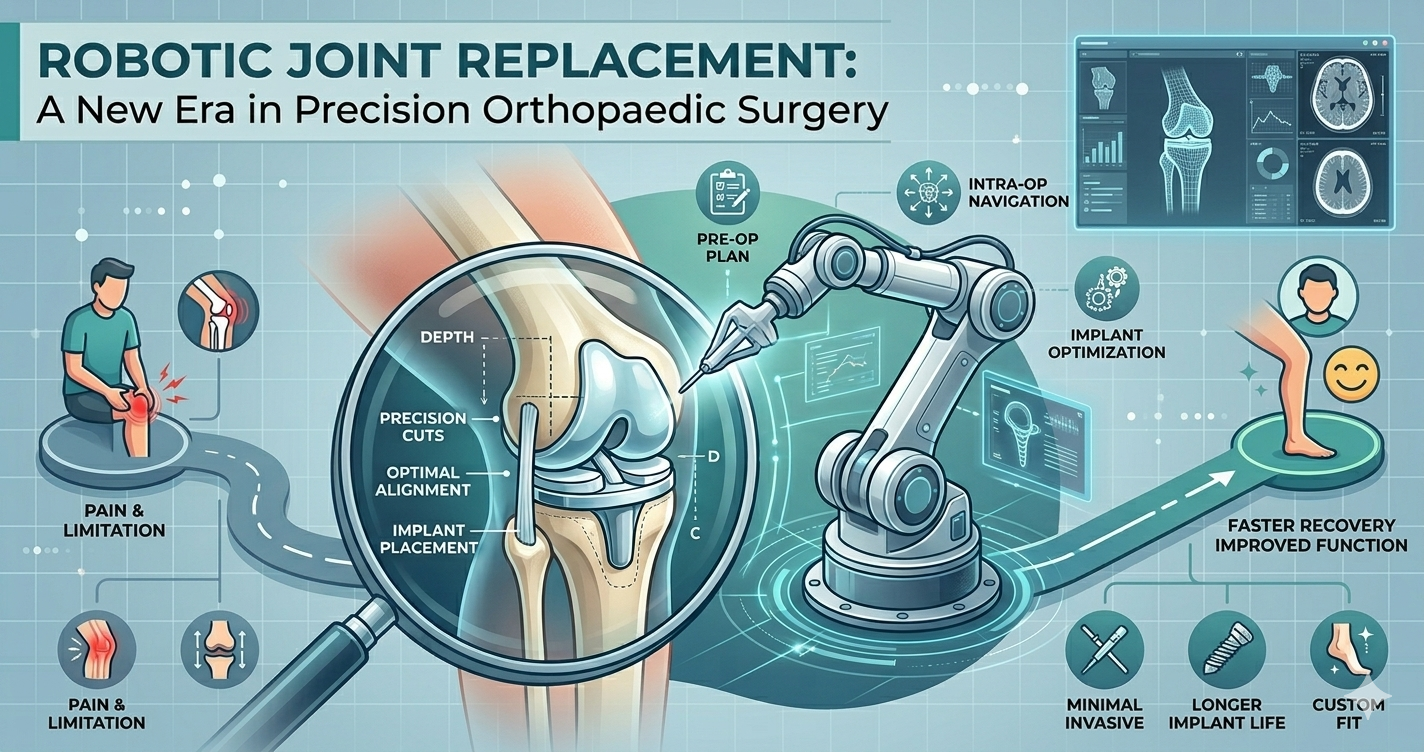
Robotic joint replacement is an advanced orthopaedic procedure in which a surgeon uses a robotic system to plan and perform joint replacement with exceptional accuracy. In robotic joint replacement surgery, detailed 3D imaging creates a personalised surgical plan before the procedure begins.
During surgery, the robotic system provides real-time guidance, helping the surgeon position implants with a precision that is difficult to achieve manually. The result is better implant alignment, reduced tissue damage, and potentially faster recovery. Common procedures include robotic knee replacement and robotic hip replacement, with the MAKO robot being one of the most widely used platforms globally.
Key Takeaways
- Surgeon-Led, Robot-Assisted: In robotic joint replacement surgery, the surgeon is always in control.
- Personalised Planning: Pre-operative 3D imaging allows surgeons to create a patient-specific plan, making robotic knee replacement surgery highly customised to each individual’s anatomy.
- Greater Precision: The MAKO robot and similar platforms provide real-time feedback during surgery, enabling micro-adjustments that improve implant positioning and joint alignment.
- Better Tissue Preservation: Robotic knee surgery minimises damage to surrounding healthy bone and soft tissue, which can lead to less post-operative pain and a quicker return to daily activities.
- Proven and Evolving Technology: Robotic-assisted knee joint replacement surgery is already improving outcomes for thousands of patients in India and worldwide, and the technology continues to advance rapidly.
What Is Robotic Assisted Knee Joint Replacement Surgery?
Robotic-assisted knee joint replacement surgery refers to the use of robotic systems that support the surgeon in performing knee replacement procedures with enhanced control and precision.
Unlike traditional methods, robotic systems provide digital guidance throughout the surgery, improving bone preparation accuracy and implant positioning. Surgeons can make micro-adjustments in real time, ensuring the implant fits perfectly with the patient’s anatomy.
This technology supports the surgeon across:
- Pre-operative planning
- Intraoperative guidance
- Real-time feedback
This high level of personalisation has made robotic-assisted knee joint replacement surgery one of the most promising advancements in modern orthopaedics.
Importantly, the need for advanced solutions like robotic joint replacement is growing rapidly in India. Studies estimate that knee osteoarthritis affects nearly 28–37% of adults in India, making it one of the most common causes of chronic knee pain and disability in the country. With an ageing population and rising obesity rates, the demand for precise and long-lasting joint replacement solutions continues to increase.
Understanding Robotic Joint Replacement
Joint pain caused by advanced arthritis or severe joint damage can rob patients of mobility and independence. For many, robotic joint replacement surgery offers the most effective path to a pain-free, active life.
In a conventional procedure, surgeons rely on manual measurements, handheld instruments, and visual estimation to prepare the bone and position the implant. While skilled surgeons achieve good results, there is an inherent margin for variability. Robotic joint replacement surgery reduces this variability by combining the surgeon’s clinical expertise with digital precision.
Before the surgery begins, detailed imaging scans are used to create a three-dimensional model of the patient’s joint. During robotic joint replacement surgery, the robotic system provides real-time guidance, ensuring that every movement aligns with the surgical plan.
Indian clinical research has supported the growing adoption of robotic technology. A study reviewing 500 robotic total knee replacement surgeries performed in India reported strong intra-operative safety and high accuracy in implant positioning, reinforcing confidence in robotic systems.
Robotic Knee Replacement: Transforming the Most Common Joint Procedure
Knee replacement is one of the most frequently performed orthopaedic surgeries in India. As the prevalence of osteoarthritis rises, so does the demand for better surgical precision.
A systematic review of Indian population-based studies has confirmed that the prevalence of knee osteoarthritis continues to rise due to ageing, obesity, and lifestyle factors. This makes precision in knee replacement more important than ever.
Robotic knee replacement has emerged as a game-changing advancement in this space. In robotic knee replacement surgery, the robotic system helps surgeons prepare the bone and place the implant with exceptional accuracy. Even small alignment errors can lead to implant wear or revision surgery risks that robotic knee replacement significantly reduces.
Experts speaking at the Indian Arthroplasty Association conference have noted that robotic knee surgeries demonstrate improved implant alignment and precision compared to conventional techniques.
Robotic knee surgery also allows surgeons to preserve healthy bone and soft tissues as much as possible, potentially leading to faster recovery and improved function.
Precise alignment is essential for:
- Long-term durability of the implant
- Restoration of natural gait and movement
- Reduction of post-operative pain
- Prevention of early implant failure or loosening
The MAKO Robot: Setting the Gold Standard
When it comes to robotic orthopaedic surgery, the MAKO robot is one of the most recognised platforms worldwide and is increasingly used in India.
The MAKO robot enables surgeons to create a CT scan-based 3D virtual model before surgery. During the procedure, it provides real-time haptic feedback, preventing cuts outside predefined boundaries and protecting healthy tissue.
Importantly, the MAKO robot does not replace the surgeon. It enhances the surgeon’s skill, precision, and control.
Benefits of Robotic Knee Replacement Surgery
The use of robotic knee replacement technology offers several potential benefits:
- Greater precision in implant placement
- Improved alignment of the joint
- Reduced damage to surrounding tissues
- Potentially faster recovery and rehabilitation
- Better long-term function of the joint
For Indian patients seeking long-lasting results, robotic knee replacement surgery represents a major advancement in orthopaedic care.
Is Robotic Joint Replacement Right for You?
Robotic joint replacement surgery may be worth considering if you:
- Have moderate to severe knee or hip arthritis
- Have not improved with physiotherapy, medications, or injections
- Want highly precise implant positioning
- Are active and wish to return to sports or demanding activities
- Have complex joint anatomy requiring customised planning
An experienced orthopaedic surgeon can evaluate whether robotic-assisted knee joint replacement surgery is the most suitable option for you.
The Future of Robotic Joint Replacement in India
The integration of robotics into orthopaedic surgery represents a major step forward in improving surgical precision and patient outcomes in India.
Looking ahead:
- AI-powered planning will enhance imaging analysis
- Smaller robotic systems will increase accessibility across tier-2 and tier-3 cities
- Robotic assistance may expand to shoulder, ankle, and spine procedures
- Improved implant materials will further extend joint longevity
Choose Precision for Your Joint Replacement Journey
Robotic joint replacement is redefining what patients in India can expect from joint replacement surgery. From personalised 3D planning to real-time intraoperative precision, robotic knee replacement surgery is setting a new benchmark in orthopaedic care.
With rising rates of osteoarthritis across the country, technologies such as robotic-assisted knee joint replacement surgery and platforms like the MAKO robot are helping patients return to active, pain-free lives with greater confidence and precision than ever before.
Consulting an experienced orthopaedic surgeon is the first step toward a safer, more accurate, and longer-lasting joint replacement outcome.
FAQs
1. What is robotic joint replacement?
Robotic joint replacement is a surgical procedure in which a robotic system assists the surgeon in planning and performing joint replacement with enhanced accuracy and personalisation based on the patient’s unique anatomy.
2. Is the robot performing my surgery?
No. The surgeon is always in full control. The MAKO robot and similar systems provide guidance and feedback — they do not operate independently.
3. What is the MAKO robot used for?
The MAKO robot is used to assist surgeons during robotic knee replacement surgery and hip replacement, providing real-time haptic guidance and patient-specific 3D surgical planning.
4. How is robotic knee replacement different from traditional surgery?
Robotic knee replacement uses pre-operative 3D planning and intraoperative digital guidance to improve implant positioning, offering greater precision than conventional manual techniques.
5. Is robotic joint replacement surgery safe?
Robotic joint replacement surgery has a strong safety profile. It is performed by trained orthopaedic surgeons and may reduce certain risks, such as implant misalignment, compared to conventional techniques.
6. How long is the recovery after robotic knee surgery?
Recovery varies, but many patients undergoing robotic knee surgery are walking within hours of the procedure and return to daily activities within weeks. Full rehabilitation typically takes three to six months.
7. Who is a good candidate for robotic assisted knee joint replacement surgery?
Patients with moderate to severe knee arthritis who have not responded to conservative treatments are generally good candidates for robotic-assisted knee joint replacement surgery. A consultation with an orthopaedic specialist is essential.
8. Does robotic knee replacement surgery cost more?
The cost of robotic knee replacement surgery may be higher due to the technology involved. However, improved long-term outcomes may offset this by reducing the likelihood of revision surgery. Check with your hospital or insurer for specific pricing.
9. Are outcomes better with robotic knee replacement?
Clinical evidence suggests that robotic knee replacement offers improved implant alignment and patient satisfaction compared to conventional methods, though individual outcomes depend on patient health, implant type, and rehabilitation.
10. How do I find a surgeon who performs robotic knee surgery?
Ask your GP for a referral to an orthopaedic specialist trained in robotic knee surgery. Look for surgeons with experience using platforms such as the MAKO robot and ask about their case volume and patient outcomes